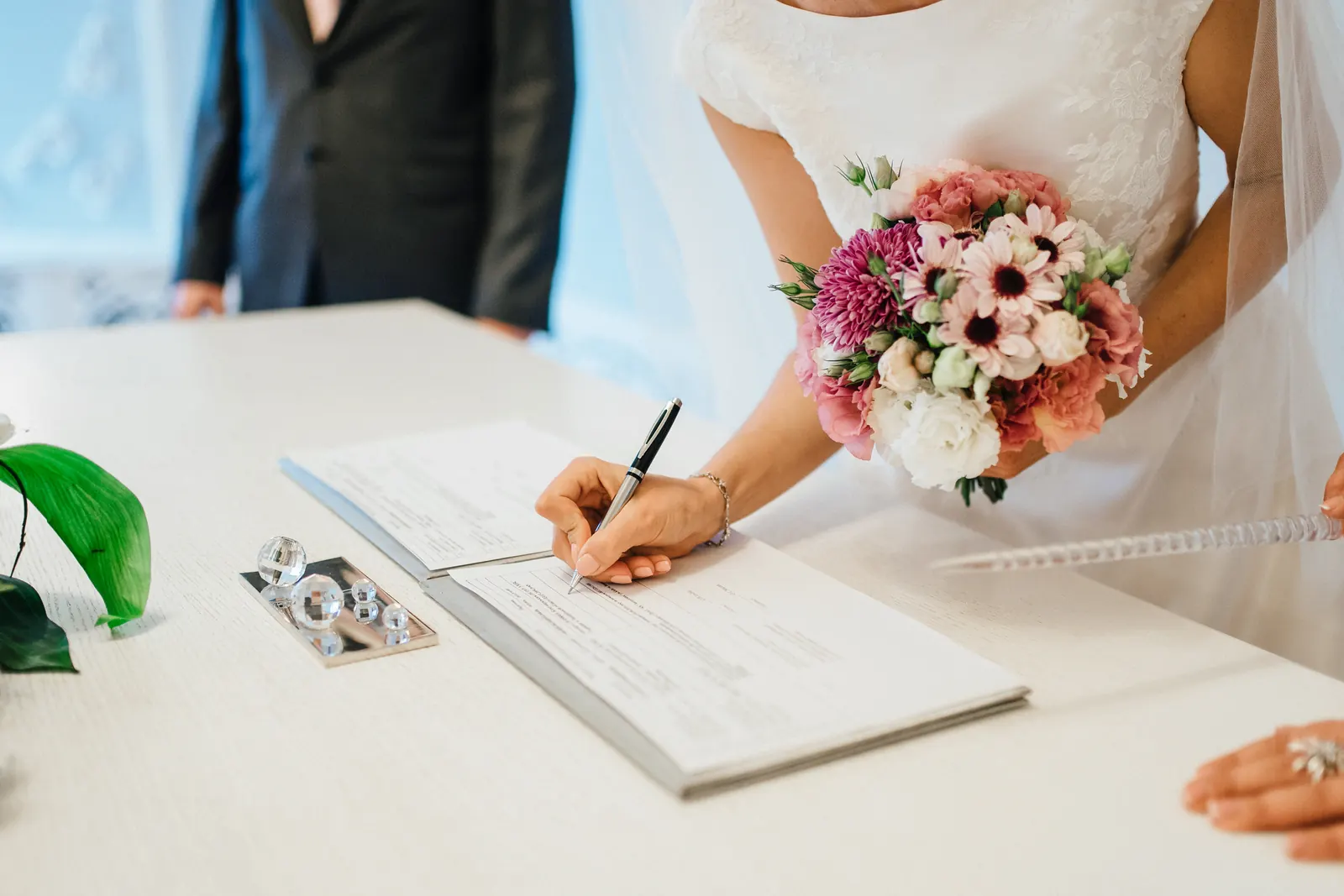
Yes, you can get married in Turkey as a foreigner, and the marriage is legally valid. Only a civil ceremony performed by a municipal marriage officer counts in law. Each of you brings a document proving you are free to marry, a birth certificate and a passport. Documents issued abroad need an apostille, then a notarised Turkish translation made in Türkiye. You also need a Turkish health report, passport photos, two witnesses and, if either of you does not speak Turkish, a sworn translator on the day. Start three to four months ahead.
Last reviewed: 29 September 2026 by the AO Events planning team. Requirements vary by municipality and by nationality, and they change. The marriage office performing your ceremony is the authority. Nothing on this page is legal advice.
Most pages about getting married in Turkey are written by law firms and translation bureaus. They list documents. Very few describe the process as what it actually is: a sequence with time attached to every step, a room you walk into on the day, and one or two points where a small delay can cost you a fortnight. This guide is written from the planning side, by people who file these papers every season, and it is organised around the question couples abroad really ask: what do we do, and when?
01The legal wedding in Turkey at a glance
| Question | Short answer |
|---|---|
| Can two foreigners marry in Turkey? | Yes, as can a foreigner and a Turkish citizen |
| Which ceremony is legally valid? | The civil ceremony only, performed by a municipal marriage officer |
| Minimum age | 18 for a straightforward application |
| Core documents | Proof you are free to marry, birth certificate, passport |
| Authentication | Apostille for documents from Hague Convention countries |
| Translation | Notarised Turkish translation, made in Türkiye |
| Made in Türkiye | Health report, application form, photos |
| On the day | Two witnesses, sworn translator if needed |
| What you receive | A Turkish family booklet and, on request, a multilingual marriage certificate |
| Realistic lead time | Three to four months of paperwork, plus working days in Türkiye before the ceremony |
02Can foreigners legally get married in Turkey?
Yes. Turkish marriage offices accept applications from two foreign nationals of the same or different nationalities, and from mixed couples where one partner is Turkish. The part that surprises many couples is the word "civil". In Türkiye, the only marriage that exists in law is the one performed by an authorised marriage officer, usually at the municipality's marriage office (the evlendirme dairesi) or, by arrangement, at an approved venue.
That has three practical consequences.
First, a religious ceremony, whether in a church, a mosque or with a celebrant you bring from home, is not a legal marriage in Türkiye on its own. Turkish law also prohibits holding a religious ceremony before the civil marriage has been registered. If a religious or cultural ceremony matters to you, it follows the civil one, often the same day or the next.
Second, the civil ceremony is short and structured. It is not a blank canvas for personalised vows. Most couples who want both the legal certainty and a ceremony that feels like theirs do the civil part first, quietly, and hold a symbolic ceremony at their venue later. We cover that structure further down.
Third, the rules are applied locally. The core list of documents comes from national regulation, but each municipality interprets the details: how many photos, how recent a document must be, whether they want to pre-check scans, how many working days they need before the ceremony. Two couples with identical paperwork can hear slightly different instructions in Bodrum and in Istanbul. This is normal, and it is why you confirm everything with the office that will marry you.
03The documents each of you needs
Every foreign partner needs the documents below. Rows marked "if applicable" depend on your history.
| Document | What it proves | Where it comes from | What happens to it |
|---|---|---|---|
| Valid passport | Identity | You | Photo page translated into Turkish and notarised in Türkiye |
| Certificate of marital status or capacity to marry | That you are free to marry | Your home authorities (the name varies by country, see below) | Apostilled at home, translated and notarised in Türkiye |
| Full birth certificate | Parents' names, place and date of birth | Your home civil registry | Apostilled, translated, notarised. Some offices waive it if the capacity document already shows these details |
| Health report | No medical impediment to marriage | A Turkish family doctor (aile hekimi) or state hospital, in Türkiye | Issued in Turkish, no translation needed |
| Passport photos | For the register and the family booklet | Any photo studio | Most offices ask for four to six per person. Kuşadası and Bayrampaşa, for example, ask for five |
| Divorce decree or death certificate (if applicable) | That a previous marriage has ended | Your home court or registry | Final decree, apostilled, translated, notarised |
| Deed poll or name change document (if applicable) | That the names across documents belong to one person | Your home authorities | Apostilled, translated, notarised |
What "capacity to marry" is called at home. In Turkish it is the evlenme ehliyet belgesi. Depending on your country it may be a certificate of no impediment, a certificate of celibacy, a single status certificate, a certificate of marital status or a sworn affidavit. What the Turkish office needs to see is your current status stated clearly as single, divorced or widowed, together with your full identity.
Two details that catch people out. Documents obtained from an honorary consulate are not accepted. And offices commonly treat documents as valid for around six months from issue, which is why ordering them too early is as risky as ordering them too late.
A rule for women who were previously married. Turkish civil law sets a waiting period of 300 days after a marriage ends before a woman can remarry. A Turkish court can lift it, typically on the basis of a medical report. If your divorce or bereavement is recent, raise this with the marriage office and a Turkish lawyer at the very start, not in month two.
04UK couples: the affidavit route
British citizens have their own procedure, and it is simpler than the older guides suggest. Since 1 March 2014 Turkish marriage offices accept an Affidavit or Affirmation of Marital Status in place of a certificate of no impediment, and British consular offices in Türkiye no longer issue Turkish-language CNIs.
- If you live in the UK: download the bilingual affidavit template from GOV.UK, swear or affirm it before a UK notary public or commissioner for oaths, then have it legalised with an apostille by the FCDO Legalisation Office before you travel. Each British partner needs their own.
- If you live in Türkiye: complete the same form and book an appointment at the British Embassy in Ankara or the consulates in Istanbul, Izmir or Antalya.
- If you were divorced or widowed: the notary or consular officer will ask to see your decree absolute or final order, or the death certificate. Keep the originals to hand.
- Validity: the sworn and apostilled affidavit is generally treated as valid for 180 days from signature, so time it for roughly three months before the wedding.
Official source: GOV.UK, Turkey affirmation or affidavit of marital status.
US citizens should start with the marriage page of the U.S. Embassy and Consulates in Türkiye, which explains what the embassy can and cannot provide. Every other nationality should ask their own embassy or consulate in Türkiye how they issue a capacity document for a Turkish marriage. Some issue it locally, some only at home.
05Translation, notary and authentication: the step that takes longest
This is the part of the process nobody warns you about, and the one we plan around most carefully. Collecting documents at home is slow but predictable. Getting them into a form a Turkish marriage officer will accept is where time disappears.
There are three routes, depending on where your documents come from.
1. Your country is a party to the Hague Apostille Convention. The UK, the US, most of Europe, Australia and many others are. Your documents get an apostille from the competent authority at home. In Türkiye, a sworn translator translates them into Turkish and a Turkish notary certifies the translation. That is the whole chain.
2. Your country is not a party to the Convention. The document must be legalised through the Turkish embassy or consulate in your country, and then processed in Türkiye. Documents issued by your country's consulate in Türkiye typically need approval from the local district governorship (kaymakamlık) or the provincial governor's office (valilik) before they are translated and notarised. Authentication at a governor's office is the step that quietly eats time: in our experience it can add up to two weeks in peak season, and it is the most common reason a date comes under pressure.
3. Your documents are multilingual and include Turkish. Some countries issue international multilingual civil status extracts in a format that includes Turkish. Marriage offices generally accept these directly, without further authentication or translation. Ask your registry whether it can issue one.
Practical rules we follow on every file:
- Never translate at home. A translation made abroad, even by a certified translator, usually has to be redone in Türkiye. Bring apostilled originals and let the notarised translation happen here.
- Scan everything the day it arrives. Your planner can ask the marriage office to pre-check scans, which catches a missing parent's name or a mismatched spelling before you fly.
- Match the spellings. A name spelled one way on a passport and another on a birth certificate, including accents and middle names, is the single most common reason a file is sent back.
- Keep originals together. The office may want to see originals alongside notarised translations.
06How far ahead to start: a real month-by-month sequence
Below is the sequence we work to. It assumes a peak-season wedding, both partners resident abroad and a Hague Convention country. Adjust it once your municipality has confirmed its own lead times.

Nine to twelve months before. Choose your region and a date window. Our coast guide and overview of getting married on Turkey's coast are the place to start. Decide whether the legal ceremony happens in Türkiye or at home. If it happens here, your planner identifies which municipality will perform it and whether it will send an officer to your venue. Read our guide to the best time to get married in Turkey before you commit to a month.
Six months before. Confirm the municipality's current document list and how recent each document must be. Order full birth certificates now, because some registries are slow. Check both passports: they need enough validity for your trip, and your guests will need the same check (see our guide for wedding guests).
Four months before. Book the date with the marriage office if it accepts advance bookings, and book a sworn translator for both the application and the ceremony.
Three months before. Obtain your capacity-to-marry document or sworn affidavit, then apostille everything. This timing keeps all documents inside a six-month validity window on the wedding day.
Six to eight weeks before. Send scans to your planner for a pre-check with the marriage office. Correct anything flagged while there is still time.
Two weeks before. Confirm your two witnesses, their passport details and their arrival dates. Confirm the translator's time and the officer's time on the day.
On arrival, before the ceremony. Plan to be in Türkiye on working days before the wedding, not only at the weekend. In that window the notarised translations are completed, you visit a family doctor or state hospital for the health report, you submit the application form (evlenme beyannamesi) and photos, and you pay the municipal fees. Most of our couples arrive three to five working days ahead, and your municipality tells you its minimum.
After the ceremony. Stay at least one working day. If you want a multilingual certificate or an apostille on it, that is when you collect it.
07What happens on the day at the municipality
This is the part no document list describes, and the part couples are most curious about.
Where it happens. Either in the municipality's marriage hall, which in many coastal towns is a bright, formal room with a long table and rows of seats for guests, or at your venue, if the municipality sends an officer to you. A ceremony in the hall is usually the most straightforward. A ceremony at the venue costs more and is subject to the officer's schedule, which is one reason our run sheets always hold a buffer before the ceremony time.
Who stands where. The marriage officer sits at the centre of the table. The two of you sit facing the guests, side by side, with a witness beside each of you. The translator stands or sits close to the officer, because every question will pass through them.
What is said. The officer confirms your identities, then asks each of you, in turn, whether you consent to marry the other. The translator interprets the question, you answer, and the translator confirms your answer back to the officer in Turkish. You then sign the register, followed by the witnesses. The officer declares you married under Turkish law.
What you receive. The officer hands over the Turkish family booklet, the aile cüzdanı. By long-standing custom it is handed to the bride, and guests often cheer when it is. On request, the office also issues a multilingual marriage certificate, which is the document you will use back home.
How long it takes. The formal part is brief, often ten to fifteen minutes. Guests are frequently surprised by how quickly it moves, so plan the music, the exit and the photographs around a short ceremony rather than a long one.
A tradition worth knowing. At Turkish civil ceremonies, the moment after signing is often a small contest: whoever steps on the other's foot first is said to have the final word in the marriage. You will almost certainly see a guest encourage it. We tell couples in advance, so it ends up in the photographs rather than as a surprise.
08Witnesses, language and the translator
Witnesses. You need two adults with valid identity documents. They can be friends or family from your guest list. They do not need to speak Turkish, and they do not need to be Turkish. Send their passport details to your planner early, because some offices record them in advance.
Language. The ceremony is conducted in Turkish. If either of you does not speak Turkish, a sworn translator must be present at the application and at the ceremony. This is a legal requirement.
What the translator is for. The translator is there so the marriage officer can be certain you both understood what you consented to. Choose one who is authorised for this work, confirmed well in advance, and briefed on the timing. In our experience the translator is the single person most likely to be double-booked on a Saturday in June, so book them as early as you book the officer.
09Having your marriage recognised back home
A Turkish civil marriage is a real marriage, and most countries recognise a marriage that was valid where it took place. What you need is proof that is easy for your home authorities to read.
- Ask for the multilingual marriage certificate at the marriage office. It saves a translation later.
- Get an apostille on it in Türkiye if your home authorities will ask for one. Turkish civil registry documents are apostilled by the local governorship. Your planner can collect it after the ceremony, which is another reason to stay an extra working day.
- UK couples: the UK generally recognises the marriage, but it is not added to UK marriage records and cannot be registered later at a UK register office or consulate. Keep the apostilled certificate safely. It is the document you will show for name changes and official purposes.
- US couples: recognition is generally automatic if the marriage was valid in Türkiye. Keep the multilingual certificate with an apostille for name changes and federal paperwork.
- Changing your name: use the marriage certificate with your passport office or equivalent authority. Requirements are set at home, not in Türkiye.
10The alternative: marry legally at home, celebrate in Türkiye
A significant share of our couples choose this route, and it is worth considering honestly.
You complete the legal marriage at home, at a register office or with a local officiant, in the weeks before you travel. In Türkiye, you hold a symbolic ceremony at your venue. There is no document chain, no translation, no health report and no municipal timetable. The ceremony can happen at any hour, in any language, led by anyone you choose, with vows you wrote yourselves. The light, not the officer's diary, decides the time.
The trade-off is the moment itself. Some couples want the legal marriage to happen in the place they chose, with the people who flew in for it. If that matters to you, the civil route is entirely workable. If what matters is the ceremony, the vows and the evening, a symbolic ceremony is usually the calmer path.
Either way, the choice changes your budget and your schedule. Our breakdown of what a wedding in Turkey actually costs shows where the legal line sits in the overall spend, and the season guide shows which months make a late-afternoon symbolic ceremony work best.
11A note for Muslim couples: nikah and the civil ceremony
Many Muslim families want a religious nikah alongside the civil marriage. In Türkiye this is common and straightforward, as long as the order is respected: the civil marriage comes first, the nikah follows. We explain how families usually structure the two, and the rest of the celebration, in our guide to halal weddings in Turkey.
·Questions we are asked every week
Can foreigners get married in Turkey? Yes. Two foreigners, or a foreigner and a Turkish citizen, can marry in Turkey. Only a civil marriage performed by a municipal marriage officer is legally valid. A religious ceremony can follow it but cannot replace it.
Is a marriage in Turkey legally recognised in the UK? The UK generally recognises a marriage that was legally valid in the country where it took place. It is not added to UK marriage records, so keep the Turkish certificate, ideally the multilingual version with an apostille.
Do British citizens need a certificate of no impediment to marry in Turkey? No. Since 1 March 2014 Turkish marriage offices accept a bilingual Affidavit or Affirmation of Marital Status instead. UK residents swear it before a UK notary or commissioner for oaths and have it apostilled by the FCDO before travelling.
How long does the legal process take? Allow three to four months to gather, apostille and translate documents at home, then plan to be in Turkey on working days before the ceremony for translations, the health report and the application. Your municipality confirms the exact lead time.
Do we need a translator at the ceremony? If either of you does not speak Turkish, a sworn translator must attend the application and the ceremony. This is a legal requirement, not a courtesy.
How many witnesses do we need? Two adult witnesses with valid ID or passports. They can be guests, and they do not need to speak Turkish.
Can we have a beach or garden ceremony that is legally binding? Many municipalities will send a marriage officer to an approved venue for an additional fee. Whether your venue qualifies is decided by the municipality, so confirm it before you book.
Can we have a religious ceremony instead of a civil one? Not as a legal marriage. Turkish law only recognises the civil ceremony, and a religious ceremony may only take place after the civil marriage is registered.
·Get the document checklist
We keep a one-page checklist of every document, every validity window and every step in the order we file them. Tell us your nationalities and your region and we will send the version that applies to you.
This guide is general information for planning purposes and is not legal or immigration advice. Marriage requirements are set by Turkish regulation, applied by each municipality, and depend on your nationality and personal history. Always confirm the current requirements with the marriage office that will perform your ceremony and, where relevant, with your own embassy. Last reviewed 29 September 2026.